


In Istanbul, a woman who said “I have to work for a living and I am in good health” was asked to get off a bus, which was met with calls for support and solidarity from the moment it appeared on social media.
However, a statement two days later surprised us all.
The statement reads, “According to the Istanbul Governorship Hygiene decision, all citizens over the age of 65 and under the age of 20 are prevented from using public transportation as of January 15, 2021 within the scope of Covid-19 measures.”
As the 65+ Elderly Rights Association, we call on the Governorate of Istanbul to review and correct this un pecified “wholesale” ban decision.
For months, we have been emphasizing the following facts and bringing them to the attention of the authorities:
- The stereotype “retired, sitting in a corner of the house person” does not apply for everyone aged 65 and over. In Turkey, according to official data, 12.5% of the 65+ population and 21% of the elderly male population are working (TurkStat, Statistics on the Elderly, 2019).
- Some of these people work in irregular jobs, meaning that they are not eligible for the benefits provided to working people under COVID-19 restrictions. A significant number of them are self-employed, artisans, meaning that they need attain personally their businesses. Some of them have to go out on the streets either to take care of their grandchildren or elderly spouses, or for their own health needs.
- Despite this, there is already a big decline in public transportation trips for the elderly in Istanbul. In November, compared to October, the number of passengers aged 60 and over dropped from 8,177,094 to 5,806,850, a decrease of about 1/3 (Istanbul Transportation Bulletin, December 2020).
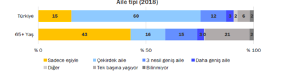
- 40% of our elderly live in households with nuclear or larger families. (KONDA, Aging Report, October 2020) These family members work, go out for various reasons, and use public transportation. In other words, they are likely to carry the COVID-19 virus home. In this case, there is no scientific data on how much locking 65+ individuals at home will reduce the risk of transmission.
- It is a fact that COVID-19 is mostly transmitted at home. Minister of Health, Dr. Fahrettin Koca, emphasized this once again by announcing that the domestic transmission rates rose to 85% in December.

- Two out of every three elderly people (64%) live at home with their spouse or alone. Evening and weekend curfews have severely limited the ability of other generations to provide support to their relatives over 65.
In this period when pandemic conditions are putting pressure on everyone, there are restrictions that we all follow, but the introduction of additional restrictions based only on age makes life even more difficult for those over 65. In addition to immobility and demoralization, they can lose their hopes and income. Unfortunately, we are also observing an increase in elderly deaths and serious diseases due to non-COVID-19 reasons. Until vaccination starts and the first good results are obtained, we believe that it is possible to relax age-specific restrictions without neglecting precaution.
We know that fundamental rights guaranteed by the Constitution can be restricted in times of pandemic. However, many legal experts emphasize that these restrictions should be measured, proportionate, and time-limited, and that restrictions and bans on individuals aged 65 and over exceed these limits and reach the level of “violation of rights”.
Poet-writer Ataol Behramoğlu and lawyer Canan Arın filed a lawsuit with the Administrative Courts for the annulment of the bans on these grounds. Such lawsuits may increase, creating an unnecessary legal problem that pits the state and citizens against each other.
The fact that the right to free/discounted use of public transportation, which is the most important privilege granted to the elderly in Turkey, regulated by law, can be dismissed so easily and in such a wholesale manner, frightens those of us working for the rights of the elderly.
We call on the authorities to review and correct this decision.
We expect the authorities at all levels to ask themselves the following questions before deciding on bans and restrictions on the elderly: “Since the outbreak of the pandemic in February 2020, what have we added to the services we provide to senior citizens within our jurisdiction, how much have we increased the financial resources and manpower we allocate for these services?”
All of us deserve to know the answers to these questions, but most of all the elderly, whom we hold in high esteem.