We express our gratitude to the aid teams and volunteers who worked hard in the earthquake zone, and to those who forgot their own troubles and ran to their neighbors. Our minds and hearts are with them.
Search and rescue operations in the region are urgent and prioritized. However, especially due to the cold weather conditions and difficulties in accessing basic necessities, assistance and support efforts for vulnerable groups also gain importance.
The elderly are a vulnerable group, as are the disabled and children. Disasters also create new challenges and problems for them.
The proportion of the population aged 65 and over in the earthquake zone is 4% in Ş.Urfa, 5% in Diyarbakır, and 6% in G.Antep. However, the proportion of the elderly population is 8% in Adıyaman, Kilis, Hatay, 9% in Adana, K.Maraş and Osmaniye, and 11% in Malatya, which is above the average of Turkey.
With this data in mind, we would like to remind the teams, volunteers and relatives of the elderly in the earthquake zone to pay attention to the following issues.
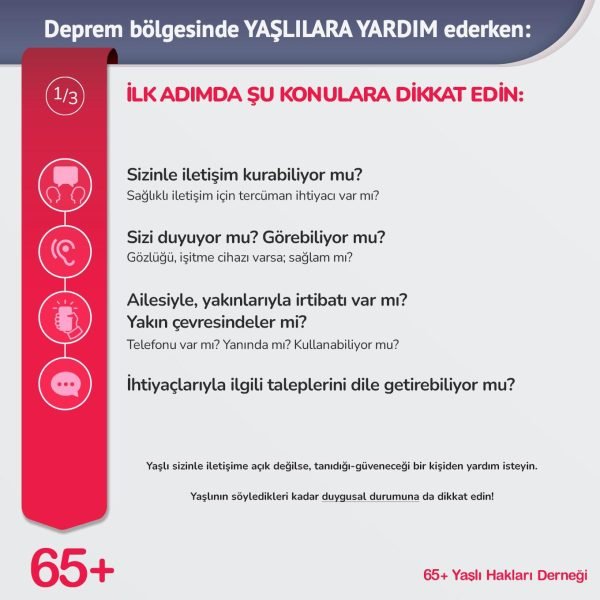
While HELPING THE ELDERLY in the earthquake zone:
1/3. PAY ATTENTION TO THE FOLLOWING ISSUES AT THE FIRST MOMENT:
– Can he/she communicate with you?
o Does he/she need an interpreter for healthy communication?
– Can he/she hear you? Can he/she see?
o If he/she has glasses or hearing aids, are they intact?
– Does he/she have contact with his/her family and relatives? Are they in the immediate vicinity?
o Does he/she have a cell phone, does he/she use it, does he/she have it with him/her?
– Can they express their requests about their needs?
If the elderly person is not open to communicating with you, ask for help from someone they know and trust.
Pay attention to the emotional state of the elderly as well as what they say!
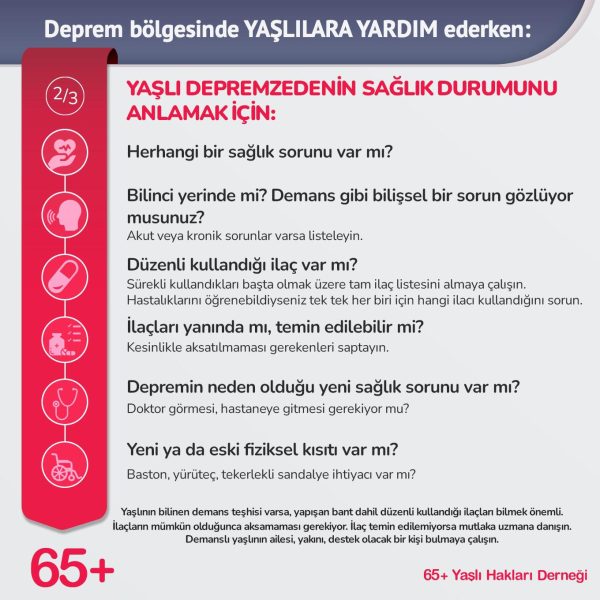
2/3. TO UNDERSTAND THE HEALTH STATUS OF THE ELDERLY EARTHQUAKE SURVIVOR:
– Is there any health problem?
– Is he/she conscious? Do you observe any cognitive problems such as dementia?
o List any acute or chronic problems.
– Are there any regular medications?
o Try to get a complete list of medications, especially those he/she uses continuously.
o If you were able to find out their diseases, ask what medication they take for each one.
– Does he/she have his/her medication with him/her, are they available?
o Identify the ones that absolutely must not be skipped.
– Are there any new health problems caused by the earthquake?
o Does he/she need to go to the hospital to see a doctor?
– Are there any new or old physical limitations?
o Does he/she need a cane, walker, wheelchair?
If the elderly person has a known diagnosis of dementia, it is important to know the medications they take regularly, including patches.
Medications should be taken as regularly as possible. If medication is not available, consult a specialist. Try to find a family member or relative of the elderly person with dementia to support them.
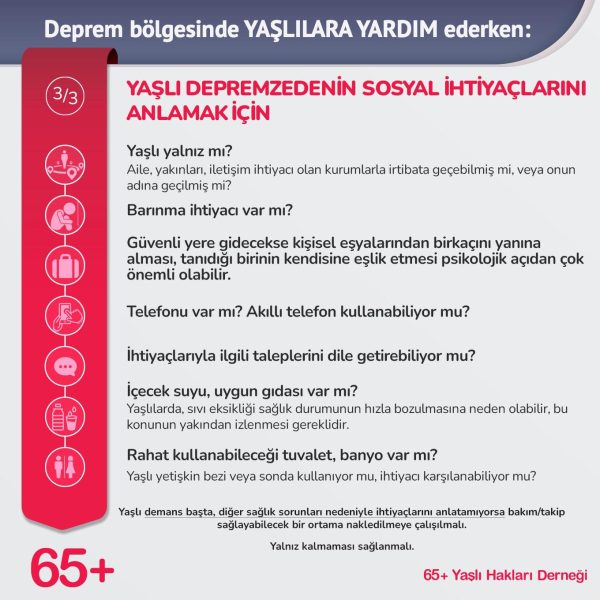
3/3. TO UNDERSTAND THE SOCIAL NEEDS OF THE ELDERLY EARTHQUAKE SURVIVOR
– Is the elderly person alone?
o Has the person been able to contact family, or has this been done on his/her behalf?
– Is there a need for shelter?
– If he/she is going to a safe place, it may be psychologically very important for him/her to take some of his/her personal belongings with him/her and to be accompanied by someone he/she knows.
– Does he/she have a cell phone? Can he/she use a smartphone?
– Can he/she express his/her demands about his/her needs?
– Does he/she have water to drink and appropriate food?
o In the elderly, lack of fluids can cause rapid deterioration in health status, this issue should be closely monitored.
– Is there a toilet and bathroom that they can use comfortably?
o Does the elderly adult use diapers or catheters, can their needs be met?
If the elderly person is unable to express his/her needs due to dementia or other health problems, efforts should be made to transfer him/her to an environment that can provide care/follow-up.
It should be ensured that he/she is not left alone.